

HoN Project – Human Origins in Namibia (2015-2023)
An archaeological fieldwork project
In short
The Human Origins in Namibia (HoN) project was initiated in 2015 with the financial support of the French Ministry Foreign of Affairs Commission on Archaeological Excavations (Commission des fouilles), Inrap, UMR 5608 TRACES (CNRS / Université Toulouse Jean-Jaurès) and IFAS-Research.
The HoN project, led by Laurent Bruxelles (UMR 5608-TRACES, IFAS-Research), is an archaeological fieldwork project aiming to find new fragments of the “Cradle of Humankind” by extending their research beyond South Africa. From December 2015 to September 2018, five missions were conducted in the Aha Hills, in Namibia, and allowed the discovery of sedimentary breccia in a karstic formation — that is, a potential fossiliferous trap.

Why?
To date, two main regions in Africa are considered “cradle of humankind“, where fossiliferous sites yielded ancient hominins, including Australopithecus, Paranthropus and Homo, covering the period of appearance of the genus Homo: the Great East African Rift and the South African karsts. These two regions, separated by approximately 4000km, show a parallel but complementary recording of this long evolutionary process.
However, the region between the Great East African Rift and the South African karst remains little known meanwhile hominins most likely occupied this area. This lack of research represents an important scientific gap in understanding the distribution of Australopithecus and Paranthropus across the continent, as well as the relationships between these two species and their connection to the emergence of the genus Homo.
What?
The HoN research project aims to identify new geological fossiliferous trapsparticularly focusing on karst systems, that may have preserved other pieces of the “Cradle of Humankind”. Currently-known sites of the region were preserved by specific geological and geomorphological contexts (rift in East Africa and karst in South Africa) which favoured fossil conservation. The HoN Project intends to find other sites in Southern Africa which gather the geological and geomorphological conditions necessary to become “fossiliferous traps”.

Map showing locations of the Great East African Rift (black lines) and the main plaeoanthropological sites found within it (red dots), as well as the main plaeoanthropological sites documented in Southern African karst systems (blue dots). Purple circles indicate location of current research programs (HON and HOMME). © L. Bruxelles
Where?
The project focuses on the Aha Hills, located partlyin northeastern Namibia and western Botswana. This area was selected for several reasons:
- Geology: The Aha Hills are formed within limestone and dolomite of the Damara formation, which are particularly favorable for the development of extensive caves and karst systems. Such caves may have acted as natural traps for animals and sediments, constituting valuable paleontological and paleoenvironmental archives.
- Geomorphology: The karst systems of Aha Hills already existed between 4 and 1 million years ago, a key period for understanding the emergence of the genus Homo. Additionally, the Aha Hills are situated near the headwaters of the regional hydrographic system, reducing the likelyhood that the oldest sediments were washed away and increasing the potential for fossil formation and preservation.
- Literature: Research conducted by Martin Pickford during the 1980s on the Botswana side of the Aha Hills suggested the presence of significant Plio-Pleistocene faunal remains, similar to those documented in the South African Cradle of Humankind (Sterkfontein and Makapansgat).
- Lack of research: Although several cavities are known in the Aha Hills, no systematic surveying nor karstic fillings studies have yet been conducted in this region.

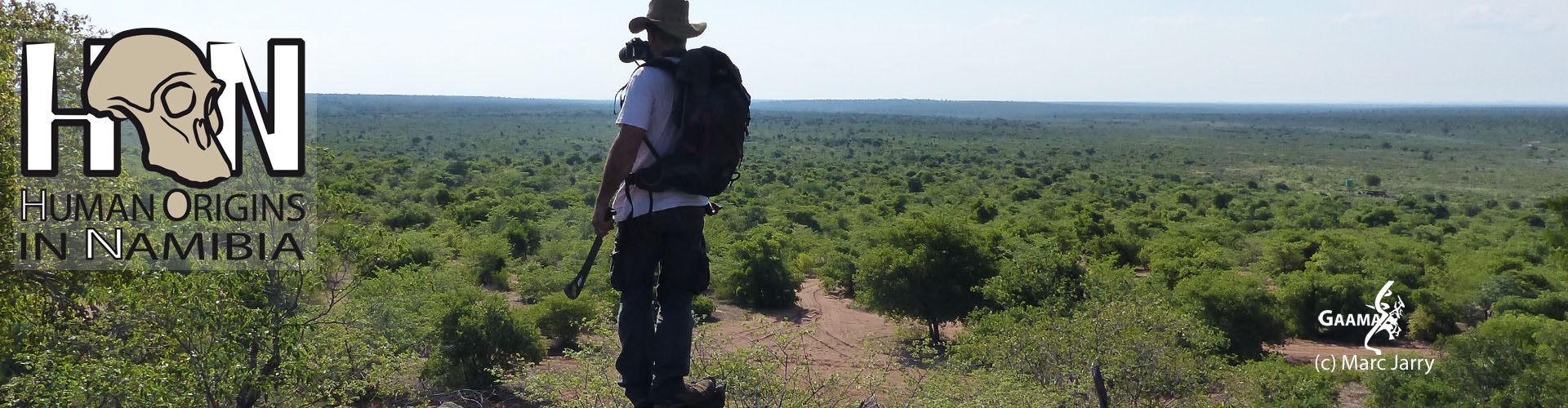
© M. Jarry
How?
The methodology of the HoN project relies mainly on systematic surface and cave surveys. All surface traces of caves, breccias or calcite deposits are listed, characterised and mapped within a GIS (Geographic Information System). Speleological surveys allow to understand the formation processes and sediment accumulation within each cave, thereby assessing their potential fossil preservation.
When paleontological remains are discovered, palaeontologists of the team are able to provide a first on-site estimation of their age, after which the material may be dated using the most appropriate methodology. Depending on the potential for hominin fossils, the project will apply for test-pit and excavation permits.
Who?
The project is led by Laurent Bruxelles (INRAP, UMR 5608-TRACES, IFAS-Research). This project associates a multidisciplinary scientific team, South African laboratories and Southern African students.

Laurent Bruxelles, Geologist/Karstologist, Inrap | CNRS | IFAS-Research


Timeline
Mission I – December 2015

The first HoN mission was dedicated to prospecting the Aha Hills: testing their accessibility, their potential for fossil preservation and the conditions of future surveying.
The mission started with a visit to Gcwihaba (Drotsky) Cave, on the Botswana side of the Aha Hills, where breccia containing fossil bones was found. On the Namibian side, the team extensively surveyed five hills. Although they didn’t find any cave, they identified two Middle Stone Age sites, which confirmed the long-lasting human occupation of the hills.
> Watch the HoN Episode 1 film
Mission II – April 2016


During this second survey mission, six new hills were surveyed. Although no cave was found, promising clues, such as a collapsed cave mouth, improved the understanding of the karstic massif. A second Middle Stone Age and four Late Stone Age sites were also discovered.
On the Botswana side of the border, the Gcwihaba (Drotsky) cave was further explored in order to better understand this region’s environment. The team also visited the Waxhu South sinkhole, a typical karstic trap which proved to be old enough to have trapped ancient hominid remains.
> Watch the HoN Episode 2 film
Mission III – December 2016

The exploration continued in December 2016, starting with the visit to the Waxhu North caves in Botswana. This visit confirmed that the massif is karstified: the presence of breccia and schistosity plans suggest that caves may exist beneath the sands of the Kalahari desert.
In Namibia, surveys allowed to document breccia (although these do not necessarily point to the presence of caves) along with large elements of calcite, attesting to the existence of former cavities. However, at the end of this third mission, the outcome was somewhat disappointing. Some clues were found, but no cavities. Are the Aha Hills karsified enough? Is the thick Kalahari sand concealing deep caves? The chances of finding caves and fossils seem to become thinner.
The mission ended on a first exploration of the Grootfontein and Otavi region, in Namibia, where caves could be better developed, according to what the HoN project understood on the Aha Hills geology.
> Watch the HoN Episode 3 film

Mission IV – December 2017

During this fourth mission, the team further explored the calcite outcrop discovered in 2016, which led to the discovery of an imposing stalagmitic floor, revealing a true paleokarst: an ancient cave gallery entirely filled by calcite. A photogrammatic record of the cleared surface was realized. This floor will need to be dated using the Uranium–Thorium method. After further surveying the hills within the morphological axis of the paleokarst, a new Middle Stone Age site was found, and most of all, on the top of a remote hill: a cavity!
The team then moved to the Otavi Mountains, where several old mines (of vanadium, pyrite, malachite, lead…) were explored: Berg Aukas, Kombat, Arassib 3 and the giant Asis Ost Mine.
> Watch the HoN Episode 4 film
Mission V – September 2018

During this fifth mission in the Aha Hills, the team continued the evaluation of the paleokarst discovered in 2016 in the Aha Hills, and created a 3D mapping of it.
The team then kept on exploring the Otavi region, especially in the Harasib domain, where they found breccia, with traces of microfauna remains.
> Watch the HoN Episode 5 film
Mission VI – December 2018

For the sixth mission, the team returned to the Otavi mountains. With the help of thermal imagery, the objective was to detect “fresh” air escaping from the ground and hopefully identify uncharted caves where faunal and hominin remains might be preserved. Using this approach, the team succeeded in locating fossil faunal bone-bearing breccia.
> Watch the HoN Episode 6 film
More on the Human Origins in Namibia project:
> Watch the series of videos about the HoN missions
> Laurent Bruxelles’ publication in Academia — Southern Africa as a cradle of humanity: in search of new evidence
> Vidéo Le Monde & CNRS Le Journal (in French)— À la recherche de pièges à fossiles
> Press articles on the HoN mission (in French):
- Sept.info — À la recherche des origines de l’humanité
- CNRS Le Journal — “Je me souviens…”
- CNRS Le Journal — Un berceau de l’humanité ?
> Inrap — Mission HoN, “Human Origins in Namibia”
> Grottes & Archéologie — Carnets de mission/Mission diaries (in French)
