

“Housing policy, residential and social mobility: becoming middle-class in Cape Town”
28 octobre | 28 october, 2026
Western Cape Department of Infrastructure, 27 Wale Street, Cape Town
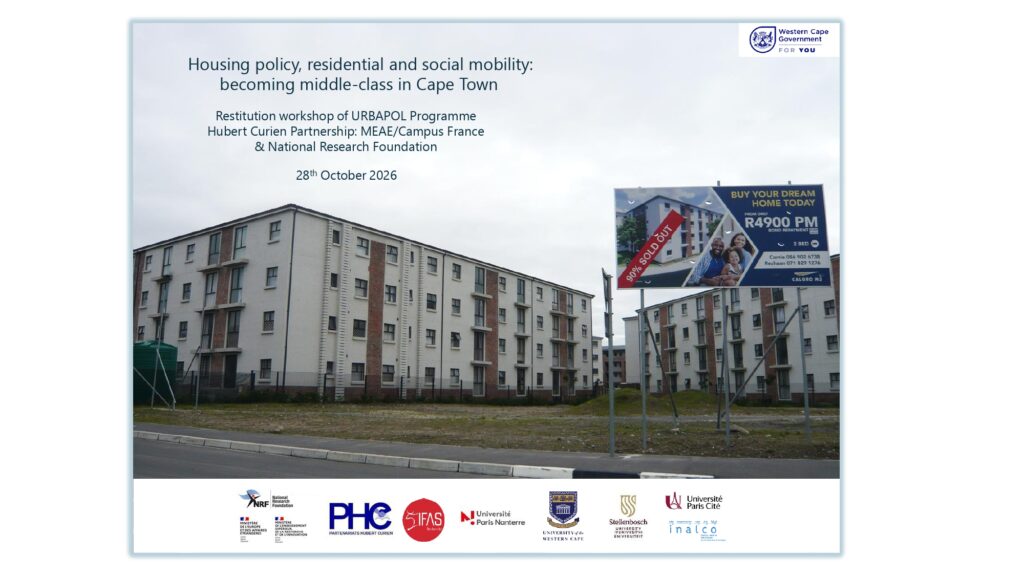
Le workshop « Housing policy, residential and social mobility: becoming middle-class in Cape Town » se tient le 28 octobre 2026 au Western Cape Department of Infrastructure (Le Cap). Soutenu par l’IFAS-Recherche dans le cadre de son appel à événements, il présente les résultats du programme Protea URBAPOL (Urbanités Politiques), un projet de recherche interdisciplinaire porté par des universités sud-africaines (Western Cape, Stellenbosch) et françaises (INALCO, Paris Nanterre, Paris Cité), cofinancé par la National Research Foundation et le gouvernement français (programme PHC). Il porte sur le First Home Finance Programme (anciennement FLISP), un dispositif de subvention destiné aux ménages situés juste au-dessus du seuil de la gratuité du logement mais exclus du marché.
Le programme croise entretiens qualitatifs sur les trajectoires résidentielles et enquête quantitative sur les conditions de vie des primo-accédant·es dans deux quartiers post-apartheid contrastés : Pelican Park–New Horizons, projet phare de la Ville du Cap, et Forest Village, projet porté par la province pour reloger des ménages précédemment déplacés. Il interroge les effets sociaux et spatiaux de cette politique, la signification politique de l’accession à la propriété pour celles et ceux qui la vivent, et ce que signifie « devenir » classe moyenne dans de tels contextes urbains. Une perspective comparative sur le cas colombien est également proposée.
The “Housing policy, residential and social mobility: becoming middle-class in Cape Town” workshop will take place on 28 October 2026 at the Western Cape Department of Infrastructure (Cape Town). Supported by IFAS-Research through its call for events, it presents the results of the URBAPOL (Political Urbanity) Protea programme, an interdisciplinary research project led by South African universities (Western Cape, Stellenbosch) and French universities (INALCO, Paris Nanterre, Paris Cité), co-funded by the National Research Foundation and the French Government (PHC programme). It focuses on the First Home Finance Programme (formerly FLISP), a subsidy scheme for households that fall just above the threshold for fully subsidised housing but remain priced out of the open market.
The programme combines qualitative interviews on residential histories with a quantitative survey of living conditions among first-time home buyers in two contrasting post-apartheid neighbourhoods: Pelican Park–New Horizons, a flagship City of Cape Town project, and Forest Village, a provincially led project developed to relocate previously displaced households. It examines the social and spatial effects of this policy, the political significance of home ownership for those who experience it, and what it means to “become” middle class in such urban contexts. A comparative perspective on the Colombian experience is also offered.